When Keir Starmer announced a national programme to triple the volume of surplus food reaching communities, it marked the most significant shift in UK food policy in a generation. For the first time, the government has recognised surplus food redistribution not as a charitable afterthought, but as core national infrastructure – essential to tackling food insecurity, reducing waste and strengthening the social fabric of the country. As a triple-benefit policy, it touches on absolutely everyone and helps reshape how the world’s fifth largest economy thinks about food.
As CEO of FareShare Yorkshire, I welcome this 10-year strategy with both optimism and realism. Optimism, because the level of ambition in the capital is finally aligned with the scale of the national challenge. Realism, because tripling redistribution is not achieved through goodwill alone. It requires investment, logistics, co-operation and a clear-eyed understanding of what surplus food can and cannot achieve. Surplus food won’t end poverty, but it will ease its sharpest edges, and that matters more than ever across Yorkshire because the depth of household and child poverty has both worsened (Joseph Rowntree Foundation, UK Poverty 2026).
For years, redistribution has relied on a patchwork of fragmented local efforts
Individual charities have done extraordinary work for their communities, but without a unified system the UK has never captured the full potential of its edible surplus. The creation of a new national programme can change that. It brings together government, the food industry, philanthropists and leading redistribution organisations behind a single shared plan. This is the first time the UK has attempted a co-ordinated, whole-system approach to surplus food, and it is long overdue.
We must be honest from the first step that surplus food is not a solution to poverty. It cannot replace fair wages, secure housing or a functioning social safety net. But every day across Yorkshire, we see the difference it makes to people in some of the hardest periods of their lives. Surplus food helps hundreds of community organisations in England’s largest county keep their doors open – from youth projects and lunch clubs to advice centres and community cafés. Without these vital lifelines, there are many people daily who would fall through the cracks, only to continue falling.
The 100,000 meals worth of food we provide each week frees up the limited resources of these organisations so they can support people with housing, debt, mental health, employment and connection. This, in turn, strengthens their wrap-around support to help people move beyond crisis, isolation and poverty, not just cope with it.
Surplus food is more than a waste solution but on a national scale it is only part of the picture. It isn’t a cure-all but is a potent component that we need to apply more intensively than ever. What remains beyond all doubt is that by tripling access to surplus food by 2036, the resulting investment in community resilience will be unprecedented.
Before us lies a decade of opportunity if we get the infrastructure right
Tripling redistribution is ambitious, but achievable. Felix and FareShare have long argued that with the right investment, the UK could unlock tens of thousands of tonnes of edible surplus every year, equivalent to 100 million meals, while reducing waste and emissions.
Yorkshire is uniquely placed to lead in this transformation, and here is exactly why.
- North Yorkshire produces the most food of any UK county.
- Yorkshire is one of the UK’s largest food manufacturing regions with major clusters in Leeds, Bradford, Hull, Selby, Malton and Wakefield.
- Few regions match Yorkshire’s breadth of food sectors (arable, livestock, horticulture, seafood, specialist foods).
- Yorkshire is at the centre of the UK’s transport spine.
- There is major food processing capacity across the region where surplus ingredients need solutions to be rescued (washing, prepping, packaging).
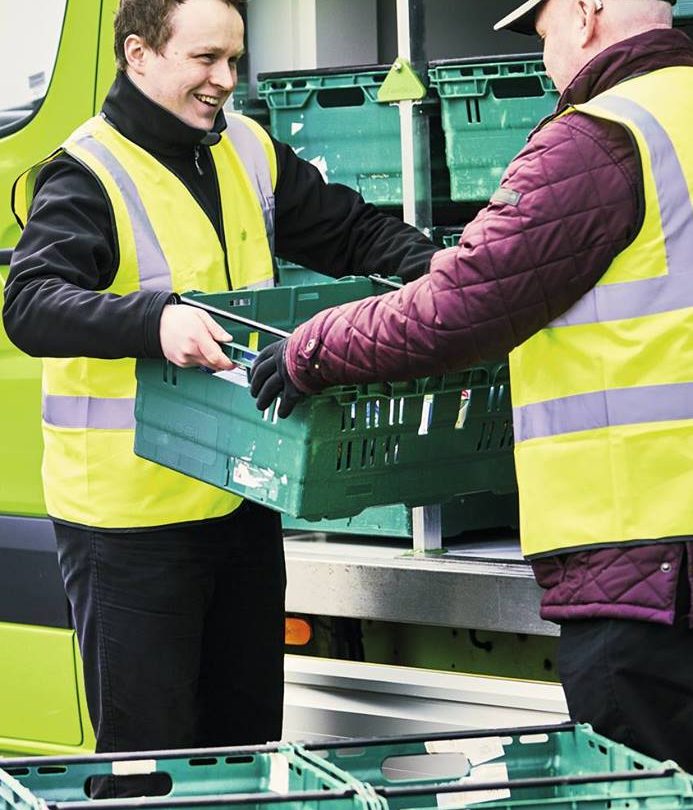
- Yorkshire has led the way in disrupting redistribution models. For example, the Regional Logistics Solution (RLS) I introduced in 2018 has generated 10 million additional meals from surplus over the last 8 years in Yorkshire. Its progression into a national model following the Haulage Crisis of 2021 has unlocked a further 6,270 tonnes (14.9 million meals) outside of Yorkshire between January 2024 – June 2026 alone.
- Our region has a dense network of community organisations who already rely on surplus food because 600,000 Yorkshire residents face food insecurity each year.
- Yorkshire has one of the most advanced food redistribution models in the UK, from agile logistics through to geographic reach, trailing only London and the Midlands for tonnes rescued.
If the national programme is to succeed, it must work for regions like ours – where need is high, distances are long, and community organisations are often the first and last line of support.
The government’s 10-year strategy is a milestone that signals long-term intent. If properly funded and delivered, it will ensure that unprecedented amounts of food no longer go to waste while people go without. It will strengthen the community organisations that hold our society together and give us a decade to build a fairer, more resilient food system.